Simple Molecules and Giant Covalent Structures
There are 2 types of covalent chemical structures: simple molecular compounds and giant covalent structures.
Simple molecular compounds are the most common type you will see. These molecules are made up of a relatively small number of covalent bonds, which makes the molecule "simple."
- Low melting/boiling points: Between each molecule, there are specific forces responsible for holding the molecules together, called "intermolecular forces." These forces are relatively weak and don't require much energy to break, giving simple molecular molecules low melting and boiling points.
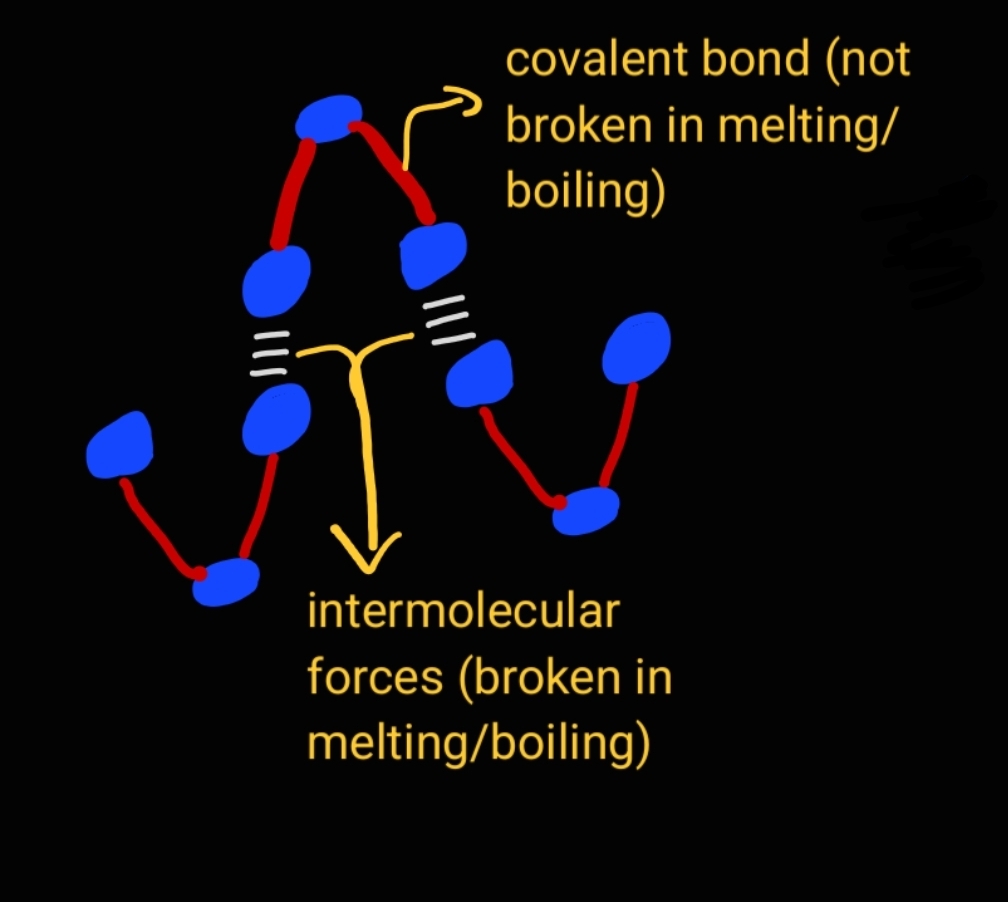
Important note: the covalent bonds are not broken when you melt or boil something. These covalent bonds remain and they are relatively quite strong. Instead, what is broken is the intermolecular forces between the molecules.
- Poor electrical conductivity: This is because they do not have any delocalized electrons or ions.
- Examples: The majority of covalent molecules you see are all simple covalent structures. For example, all the covalent molecules I drew on the covalent bonding page are simple covalent structures.

Giant covalent structures are a network of many atoms connected together by covalent bonds. There are 3 giant covalent structures you should know about: graphite, diamond, and silicon dioxide. We will go over all 3 of them (you need to be able to recognize these structures if you were shown a picture in an exam).
Graphite
First, let's look at its structure:

Blue - carbon atom
Red - covalent bond
White - intermolecular forces
As you can see, graphite is made up of carbon atoms covalently bonded together in a hexagonal arrangement to form a layer, and each layer is weakly connected to layers above and below them via the weak intermolecular forces (obviously my diagram is limited to a few layers, in reality there's a bunch). You can deduce a couple of things from this structure:
- Lubricant - Because the layers are weakly connected together via intermolecular forces, they can slide over each other quite easily. This makes graphite a good lubricant. In fact, this is why graphite is used in pencils - because the layers slide off the pencil and onto the paper.
- Good electrical conductor, allowing it to be used as electrodes - A carbon atom has 4 valence electrons. In graphite, notice how every carbon atom is forming 3 covalent bonds, which means every carbon atom is sharing 3 of its 4 electrons. This means that for every carbon atom, there is 1 electron that is not involved in bonding, instead it is delocalized and freely roaming around the structure. This allows graphite to be a good conductor of electricity, and hence used as an electrode (an electrode is an electrical conductor).
Diamond
Perhaps not the best drawing. Please refer back to your textbook or the internet for a better drawing. This is called diamond's crystal structure.
Blue - carbon atom
Red - covalent bond
So, in reality, diamond has a repeating tetrahedral structure, where every carbon atom is forming 4 covalent bonds. We can deduce a few things from this:
- Diamonds are very hard → used in cutting tools.
This is because it is completely filled with strong covalent bonds. Every carbon atom is forming 4 covalent bonds.
- Very high melting point (>3700 Celcius).
Again, because of the several covalent bonds formed.
- Not a good conductor of electricity.
An unbonded carbon atom has 4 valence electrons. In diamond, every carbon atom forms 4 covalent bonds, which means every atom is sharing all 4 electrons. Because all electrons are involved in bonding, you have no delocalized electrons that can move freely, causing diamond to be a bad electrical conductor.

Silicon Dioxide (silica)
NOTE: The silicon dioxide section will be continued in the next update to these notes.
First, what is the chemical formula of Silicon dioxide? Let's recall our naming conventions.
The structure of silicon dioxide is very similar to the structure of diamond:

Blue - carbon
Yellow - oxygen
Red - covalent bond