Drawing Atoms and Ionic Bonding
In this section, we will go over ionic, covalent, metallic bonds, and also how to draw atoms, ions, etc.
Let's start by drawing atoms. There's a few things you need to include in your drawing:
- The nucleus (and protons and neutrons).
- The electrons (how many electrons and how many electron shells).
Note:
- Where you place the electron inside the shell doesn't matter.
- When drawing ions, you must enclose the drawing with square brackets and put the charge of the ion on top.
Let's use a couple of examples to demonstrate how to draw.
Example 1: Draw a hydrogen atom.
How many protons and neutrons should be in the nucleus?
From the periodic table, we know that a hydrogen atom has 1 proton. Notice that the nucleon number of hydrogen is also 1, which means nucleon number = atomic number. This means that hydrogen typically has no neutrons.
So the nucleus should contain 1 proton and no neutrons.

How many electrons and how many electron shells?
First, we need to decide how many electrons we have. Notice that we are drawing a hydrogen atom, which means that the proton number = electron number.
Since we have 1 proton, we should have 1 electron. This is how you will distribute them in their electron shells:
- Start with the first (inner-most) shell, which can hold up to 2 electrons.
- Once you completely fill the first shell, move on to the second shell, which can hold up to 8.
- Once you completely fill the second shell, move on to the third one, which can also hold up to 8.
- Then, move on to the fourth. According to the syllabus I'm following, the biggest atom you are expected to draw is Calcium, which only has 2 electrons in its fourth shell.
- Do the above steps until you draw all the electrons that the atom/ion has.
Since we have only 1 electron, we will draw 1 shell and 1 electron inside it.

Since we now have:
- The complete nucleus,
- All the electrons in their respective shells
We have officially drawn a hydrogen atom.
Example 2: Draw a Sodium atom.
Just like before, look in the periodic table and check how many protons and neutrons does a typical sodium atom have.
You will find sodium has 11 protons and a nucleon number of 23. So neutron number = 23-11=12 neutrons.
Since it is fairly tedious to draw 23 circles in the nucleus, this is how I typically draw the nucleus:

Now, since we are drawing an atom, we know that the proton number= electron number. Hence, we will have 11 electrons.
- 2 electrons will be in the first (inner-most) shell.
- 8 electrons will go into the second shell.
- The last electron will go into the third shell.
Here is how it should look.

Example 3: Draw a chloride -1 ion.
From our naming conventions, we know that chloride is a chlorine atom that gained some electrons. But how many electrons did it gain? Well, it gained 1 electron because the charge of the ion is 1 (the negative just means "gain," as we discussed in the section on ions. If it was +1, it would mean it lost 1 electron).
Now, from the periodic table, we know that chlorine has 17 protons and has a nucleon number of 35. Hence, its neutron number = 35-17=18 neutrons.

Moreover, a chlorine atom will typically have 17 electrons (since atoms have protons = electrons), but since our chloride ion gained 1 electron, then it must have a total of 17+1=18 electrons.
- 2 electrons will be in the first (inner-most) shell.
- 8 electrons will be in the second shell.
- The last 8 electrons will be in the outermost shell.

Important tips and notes to remember when drawing ▼
- Sometimes, the exam question will ask you to draw only the valence electrons or the valence shell. In that case, only draw the outermost shell with its electrons. Never draw the inside shells or electrons.
- Sometimes, the question will tell you the number of neutrons that you are supposed to have. In that case, don't use the nucleon number in the periodic table.
- In some periodic tables, the nucleon number is not a whole number (this is because the periodic table typically shows the average nucleon number of that element, since many elements have isotopes with differing nucleon numbers). If you have to use the periodic table to decide how many neutrons you should have, round up/down the nucleon number to have a whole number.
- Again, when drawing ions, remember to enclose your ion in square brackets with the ion charge on top, same way I have drawn it in the chloride example.
- More details regarding drawing will be mentioned in future sections, when appropriate.
Chemical Bonds
I recommend you revise the goal of chemical bonds before reading forward.
Ionic bonding
Ionic bonding is the first major concept we will cover. As I said in the goal of chemical bonds section, ionic bonds occur when a transfer of electrons happens.
Rules of ionic bonds
- The bond happens between a metal and a non-metal.
- The metal gives away electrons, and the non-metal accepts those electrons. This means that the metal is an "electron donor" and the non-metal is an "electron acceptor."
- The amount of electrons donated by a metal is equal to its group number.
For example: 1) sodium is a metal in group 1, hence every sodium atom will donate only 1 electron. 2) Strontium is a metal in group 2, hence every strontium atom will donate 2 electrons.
So, electrons donated by each atom = group number of metal
Note: This rule works for metals in groups 1, 2 and 3. Group 4 metals (tin and lead) and transition metals can lose different numbers of electrons, and their charge is shown by a Roman numeral in the name (e.g. iron(III) oxide contains Fe³⁺). We'll cover these later.
- Non-metals can be somewhat confusing. electrons accepted by each atom = 8 - (group number of non-metal). Or in other words, the amount of electrons accepted by a non-metal is equal to how far away its group number is from 8.
For example, 1) phosphorus is in group 5. So, 8-5 = 3, which means that every phosphorus atom will accept 3 electrons. 2) Oxygen is in group 6. So, 8-6 = 2. So, every oxygen atom will accept 2 electrons.
- In the end, you will have ions with a complete outer electron shell.
- The name of the ionic compound will be: the name of the metal + name of the non-metal ion.
For example: Sodium chloride (metal: sodium, non-metal ion: chloride), calcium oxide (metal: calcium, non-metal ion: oxide), aluminum nitride (metal: aluminum, non-metal ion: nitride)
Rules to write the chemical formula of an ionic compound
There are 2 rules:
- You write the chemical formula for the metal before the non-metal (same way you say the name of the metal before the non-metal ion)
- I will explain this rule using an example.
Assume you have magnesium bromide. Magnesium is found in group 2, which means it wants to donate 2 electrons. Bromide is the ion of bromine, found in group 7, and 8-7=1, which means that it can only accept 1 electron. This is a problem, because electrons donated > electrons accepted (or in other words, magnesium wants to donate more electrons than 1 bromine atom can accept). How can we fix this? You bring another bromine atom to help. When you have 2 bromine atoms, each atom can accept 1 electron from magnesium, allowing magnesium to donate its 2 electrons (now electrons donated = electrons accepted). So, in order to write the correct ionic compound formula for magnesium bromide, we need 1 magnesium ion for every 2 bromide ions, or MgBr2.
But is there a faster way to determine how many atoms of metals and non-metals we need so that electrons donated = electrons accepted? Yes.

Start by writing the chemical formula for the metal and the non-metal ions, with their respective charges on top of them (remember, they have a charge because they are ions, which means they either lost or gained electron
Then, ignore the plus or minus signs and cross the numbers.
Finally, make sure the numbers are in their simplest ratio (in other words, 2 magnesium ions for every 4 bromide ions is the same thing as 1 magnesium ion for every 2 bromide ions. Since the latter is the simplest ratio, you should pick that). And, if you are left with a "1" for either your metal or non-metal, simply ignore it and don't write it.
If you are unsure whether you did it correctly or not, check if electrons donated = electrons accepted. If they are equal, it is correct (just make sure that the numbers are in their simplest ratio, and the ratio must be in whole numbers, not fractions or decimals). If they aren't equal, you did something wrong.
The examples will show you some things related to drawing that you should keep in mind.
Let us apply these rules in the following examples.
Example 1: Sodium Chloride.
- Identify the electron donor and acceptor.
Sodium is the electron donor because it is the metal, chloride (or chlorine) is the electron acceptor because it is the non-metal.
- How many electrons are given away by 1 atom of the electron donor, and how many electrons are accepted by 1 atom of the electron acceptor?
Since sodium is in group 1, then it gives away 1 electron. Chlorine is in group 7, and from the rules above, electrons accepted = 8-group number. Hence, 8-7=1, every chlorine atom will accept 1 electron.
- What is the chemical formula of sodium chloride
I will use the shortcut I showed you above.

- Draw the resulting ionic compound.
Please check with your syllabus or teachers how exactly they want the diagram to be drawn. Sometimes, they don't want the inner shells, only the outermost shell. I will draw the complete compound.

The rules of drawing are the same as they were before (just put the symbol of the element inside the nucleus instead of protons/neutrons). Remember to keep track of how many electrons each element has in their shells before you start drawing. You must always have a full outer shell.
This is known as a dot-and-cross diagram. It is given this name because the electrons are dots and crosses. Moreover, notice that sodium now has 2 shells instead of 3. This is because it lost the electron that was in the third shell.
Example 2: Aluminum oxide.
- Identify the electron donor and acceptor.
Aluminum is the metal, hence it will be the electron donor. Oxide (the ion of oxygen) is the non-metal, hence it will be the electron acceptor.
- How many electrons are given away by 1 atom of the electron donor, and how many electrons are accepted by 1 atom of the electron acceptor?
Aluminum is in group 3, which means that each aluminum atom will donate 3 electrons. Oxygen is in group 6, and electrons accepted=8-group number = 8-6=2. Therefore, each oxygen atom will accept 2 electrons.
- What is the chemical formula of aluminum oxide?
I will use the same shortcut I used previously.

Let's assume that I'm not sure whether Al2O3 is the correct formula or not. Here's how to check. ▼
- One aluminum atom will give 3 electrons, so 2 aluminum atoms will give 6 electrons. Electrons donated = 6.
- One oxygen atom will accept 2 electrons, so 3 oxygen atoms will accept 2×3=6 electrons in total. Electrons accepted = 6.
- Electrons donated = electrons accepted.
- Moreover, the numbers are in their simplest ratio (2 and 3, you can't simplify it more than that).
- Hence, it is correct!
- Draw the resulting ionic compound.
New drawing ruling to keep in mind (in addition to the dot-and-cross): It will be tedious to draw 2 complete aluminum ions and 3 complete oxygen ions. Instead, we will draw just one ion of each type and indicate how many of each ion are present by writing the number to the left of the brackets, as shown below:

Each aluminum atom lost 3 electrons, while each oxygen atom gained 2 electrons, giving them both full outer shells.
Example 3: Calcium sulfide
- Identify the electron donor and acceptor.
Calcium is the metal, so it will be the electron donor. Sulfide (the ion of sulfur) is the non-metal, so it will be the electron acceptor.
- How many electrons are given away by 1 atom of the electron donor, and how many electrons are accepted by 1 atom of the electron acceptor?
Calcium is in group 2, so it will give away 2 electrons. Sulfide (or sulfur) is in group 6, so electrons accepted = 8-group number =8-6=2.
- What is the chemical formula of calcium sulfide?
We will use the same trick we used in the previous examples.

As you can see, the shortcut we used initially told us: for every 2 calcium ions, you will need 2 sulfide ions. But that is the same as saying: for every 1 calcium ion, you will need 1 sulfide ion. And since the latter is the simplest ratio, we should pick that. Moreover, as we stated previously, if we have a 1, we can simply make it disappear, giving us a final answer of CaS.
If you are unsure, check: does electron donated=electron accepted? You will notice that it does.
- Draw the resulting ionic compound.

So are ionic compounds just 2 or 3 ions floating around in space?
No. Similar to how I told you that a typical cup of water contains trillions of trillions of particles, ionic compounds are in reality made up of a bunch of ions interacting with each other.
Ionic compounds form a "giant ionic lattice," alternating between positive and negative ions, as shown in the image.
In reality, this is supposed to be a 3D image... Just imagine it is a cube. As you can see, every ion is surrounded by ions of an opposite charge (every (+) is surrounded by several (-) and vice versa). This allows several ionic bonds (strong electrostatic attraction forces) to be present between the ions.
A general rule for you to remember: Oppositely-charged particles are attracted to each other. Same-charge particles are repelled by each other.

Characteristics of ionic compounds
- High melting/boiling points
This is because of the multiple strong ionic bonds in the lattice, which require a lot of energy to break. - Good conductors of electricity in molten or aqueous states, but not solid state
In the solid state → the ions are stuck to each other and don't move → hence preventing any electric current from flowing.
When they are in the molten/aqueous state → the ionic bonds are broken → allowing the ions to roam freely and transfer the electric current.
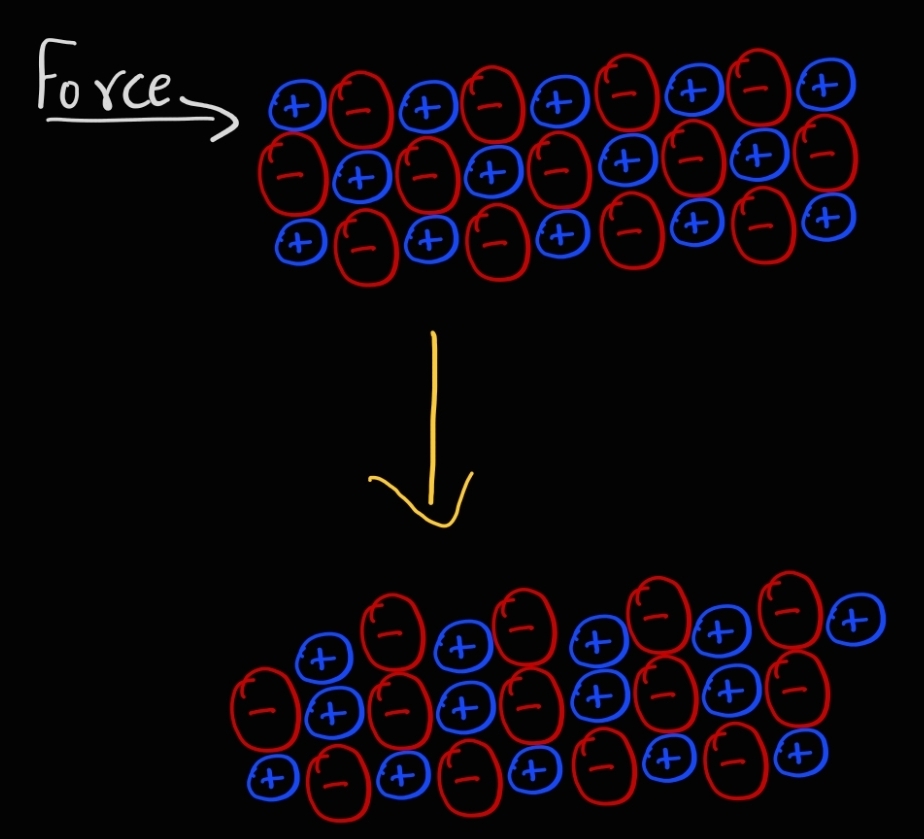
- Brittle