Derivatives and the Power Rule
All the talk about limits was to prepare you for the definition of a derivative and how to derive it using the definition. I will however not go into how to derive a derivative using the definition, and instead just present you with the normal laws and rules of differentiation, which you will be using in calculus 2 and most likely all the upcoming calculus that requires differentiating.
The best way to master differentiation is by practice. I will give you plenty of worked examples.
What does differentiation do? ▼
Differentiation allows you to figure out the gradient of a curve or a function. This will be useful in things like using the acceleration of an object to find its velocity at some point in time. It will also be useful if you wish to find the position of an object using its velocity.
Some notation to keep in mind. ▼
When you want to tell someone you are differentiating a function, you write it like this $\frac{d}{dx} f(x)$ or $f'(x)$. If you have a line/curve written like $y= ...$, then the derivative of that line will look like $\frac{dy}{dx}=...$.
4.1 Power rule
The basis of all differentiation. You use it when you want to differentiate anything in this form: $ax^n$ where:
- $a$ is just a number, like $1$, $2$, $3$, $54$, $\frac{1}{3}$, $e$, $\pi$, etc. (Basically any constant. Irrational numbers are included in this.)
- $n$ is any real number. $n$ is the power of $x$.
The derivative of $ax^n$ is $(a\cdot n)x^{n-1}$ (another way to write this: $\frac{d}{dx} (ax^n)=(a\cdot n)x^{n-1}$)
- You multiply that $a$ by whatever the power was
- You subtract $1$ from the power of $x$
Examples:
- $x^2$
$\frac{d}{dx}=(1\cdot2)x^{2-1}=2x^1=2x$ - $3x^5$
$\frac{d}{dx} (3x^5)=(3\cdot5)x^{5-1}=15x^4$ - $\frac{7}{4}x^6$
$\frac{d}{dx}(\frac{7}{4}x^6)=(\frac{7}{4}\cdot6)x^{6-1}=\frac{7\cdot6}{4}x^5=\frac{42}{4}x^5=\frac{21}{2}x^5$. Keep in mind $(\frac{7}{4}\cdot6=\frac{21}{2})$ - $3\sqrt{x}$
First, can we rewrite this $\sqrt{x}$ in a more familiar way? Yes. Here is a picture to help you.
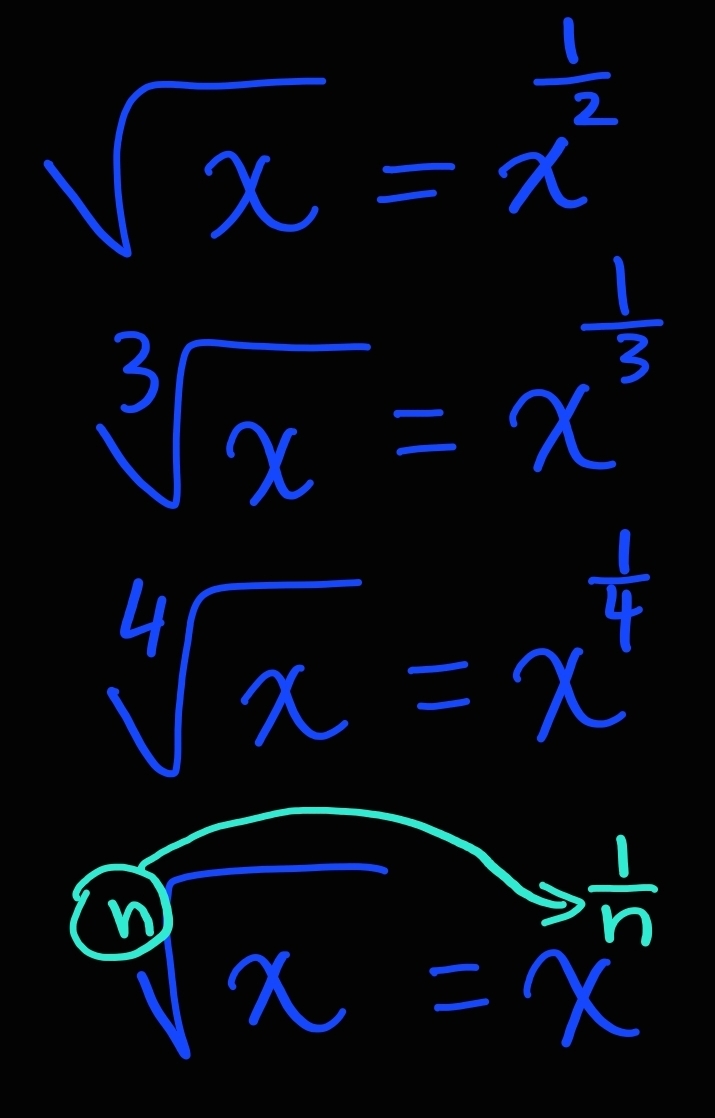
Note, if $x$ had some power, then this is how to express it: $\sqrt[n]{x^a}=x^{a\cdot\frac{1}{n}}$
So, we have $3\sqrt{x}=3x^{\frac{1}{2}}$
Now, $\frac{d}{dx}(3x^{\frac{1}{2}})=(3\cdot\frac{1}{2})x^{\frac{1}{2}-1}=\frac{3}{2}x^{-\frac{1}{2}}=\frac{3}{2x^{\frac{1}{2}}}$ - $\frac{10}{x}$
First, we want the $x$ to be up. We will raise it up and make the power negative.
We get $\frac{10}{x}=10x^{-1}$
Now, $\frac{d}{dx}(10x^{-1})=(10 \cdot -1)x^{-1-1}=-10x^{-2}=-\frac{10}{x^2}$

Some shortcuts:
- If you have a constant all by itself like $10$, $3$, $1$, $\frac{3}{2}$, $40839$, ... The derivative of that will always be 0.
- If you have a term like $x$, $10x$, $344x$, $-13x$, ... (because $x$ has a power of $1$), the derivative of that will always be the constant next to the $x$.
The below image will provide you with some examples of these 2 shortcuts.

If you are uncomfortable with any of the algebraic steps done above, I recommend practicing until you get the hang of it. Exponentials can be quite confusing.
You can also separate the terms: Similar to how we separated the terms here in our previous sections, we can separate the terms of our derivative.
For example:
- $x^2+3x+1$
$\frac{d}{dx}(x^2+3x+1)=\frac{d}{dx}(x^2)+\frac{d}{dx}(3x)+\frac{d}{dx}(1)=(2 \cdot 1)x^{2-1}+3+0=2x^1+3$ - $17x^9-22x^3$
$\frac{d}{dx}(17x^9-22x^3)=\frac{d}{dx}(17x^9)-\frac{d}{dx}(22x^3)=(17 \cdot 9)x^{9-1}-(22 \cdot 3)x^{3-1}=153x^8-66x^2$
You can also separate constants (not variables) that are multiplying with the thing you want to differentiate by pushing that constant outside and ignoring it. After you are done differentiating, multiply with that constant.
For example, $\frac{d}{dx}(3x^2)=3 \cdot \frac{d}{dx}(x^2)$. I pushed that $3$ outside.
This is generally true for any function: $\frac{d}{dx}[a \cdot f(x)]=a \cdot \frac{d}{dx} [f(x)]$, where $a$ is just any constant.
Be careful as you may start multiplying stuff you aren't supposed to multiply. Always work step by step until you are confident.