Limits at Infinity (x Approaching Infinity or Negative Infinity)
Sometimes, you need to see what happens when $x$ goes to positive or negative infinity. I will show you the intuition behind some fundamental problems, the formal way to answer questions, and some short cuts to quickly guess the solution of some problems.
Basic intuition behind fundamentals and basic formal proof
Assume someone shows you the graph of $f(x)=x$ and asks you what happens to it as $x$ approaches positive infinity. Looking at the graph, $f(x)$ continues to approach infinity as $x$ approaches infinity. What about as $x$ approaches negative infinity? Again, looking at the graph, $f(x)$ would continue approaching negative infinity.

Sadly, a mathematician wouldn't be satisfied if you told them to look at a graph to figure out the answer. Instead, that mathematician wants to see you use the "M-N of an infinite limit at infinity." I believe this definition isn't required at every course, so double check your course syllabus and check the below section for a detailed explanation.
How to use the "M-N of an infinite limit at infinity" definition
The definition states:
"We say that $\lim_{x \to \infty }f(x)=+\infty$ if, for every $M>0$, there exists a number $N>0$ such that $x>N\Rightarrow f(x)>M$"
What does it mean though? This definition relies on 2 lines, a vertical line and a horizontal line. The vertical line is $y=M$, and the horizontal line is $x=N$.
We say that $\lim_{x \to \infty }f(x)=+\infty$ if,
This part simply means that to say that the limit $\lim_{x \to \infty }f(x)$ equals $+\infty$, the following conditions must hold.for every $M>0$, there exists a number $N>0$ such that $x>N\Rightarrow f(x)>M$
This section means that if you draw any horizontal line $y=M$, you can draw a vertical line $x=N$ on the graph which guaranties that: when you move to the right of the vertical line $x=N$, $f(x)$ will always be above the horizontal line $y=M$.
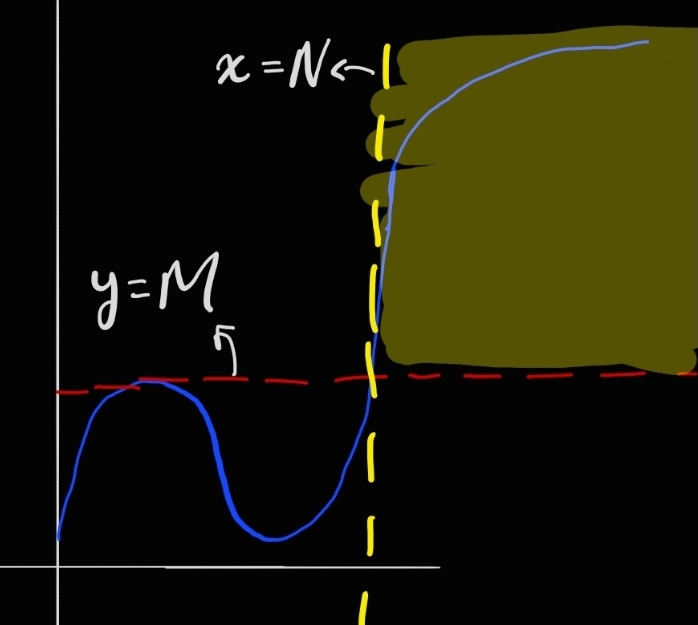
In this image, the red line is $y=M$ and the yellow line is $x=N$. As you can see, the function (the blue line) is always above $y=M$ as we move to the right of $x=N$. Therefore, this image satisfies the definition.
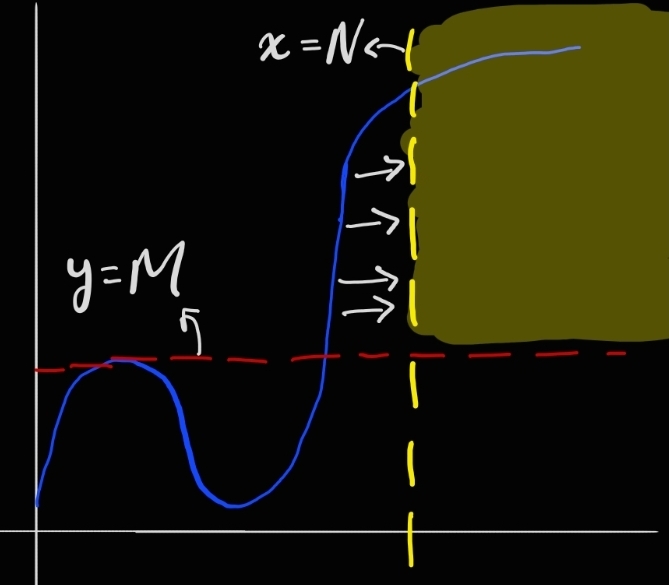
This is the same function and the same $y=M$ line; however, I moved the $x=N$ line a little bit to the right in comparison to the previous image. As you can see, even though I changed the place of the $x=N$ line, the function is still above the red $y=M$ line whenever you move to the right of the yellow $x=N$ line. So, this still satisfies the conditions of the definition.
I'm showing you this example to tell you something important: there isn't a single unique value of $N$ that satisfies the definition for a specific problem. Rather, you can pick any value for $N$ as long as you can prove that it works.
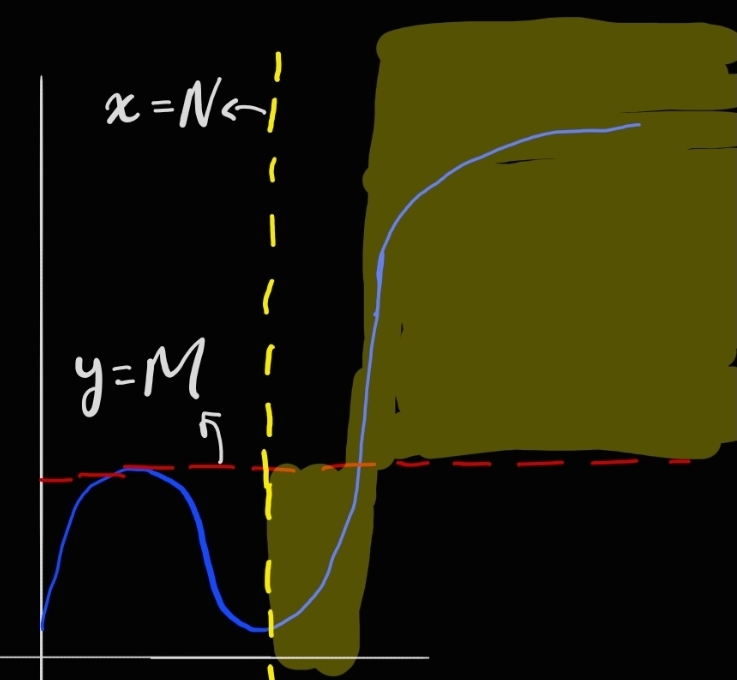
This is the same function and $y=M$ line, with the yellow $x=N$ line moved to the left. As you can see, there is now a portion of $f(x)$ that is below the red line when you move to the right of $x=N$. Hence, this image doesn't satisfy the definition.


Steps to solve problems using this definition
Similar to the formal definition of a limit, we will have a section for scratch work and a section for the formal proof. Let's start with the scratch work:
Step 1: Start with $f(x)>M$ (replace $f(x)$ with your function).
Step 2: Isolate $x$ from the inequality. Your goal is to get $x>\text{something with M}$.
Sometimes, isolating $x$ is extremely difficult or simply a waste of time. Whenever you have this problem, think of a function [I will call it $g(x)$] that is smaller than your original $f(x)$ such that you know $\lim_{x \to \infty }g(x)=+\infty$. Ideally, $g(x)$ would have an $x$ that is easier to isolate. I know that this step requires some creativity, but just remember that your goal is to find a function that works for you, not something perfect.
Here is my advice for 2 common cases where you may encounter this problem:
1- Polynomial functions: Equations like $x^{2}+8x$, $x^{4}-3x^{3}-50$, $2x^{3}-10x^{2}+1$, etc. Start with $g(x)=x$. This will usually allow you to make your $N=M+some\ number$, and I will show you how to know if the number you picked is right or not.
Steps to solve:
Step 1: Start with $f(x)$. Factor the $x$ from $f(x)$ if it helps compare it to $g(x)=x$. Example: $f(x)=3x^{3}-3x-9\to 3x(x^{2}-1)-9$
Step 2: Now, write: $f(x)>x$. Example: $3x(x^{2}-1)-9>x$. (or unfactored $f(x)$)
Step 3: Take the $x$ to the other side. Example: $3x(x^{2}-1)-x-9>0$. Your goal in step 4 to 6 is to prove this statement.
Step 4: Pick a number that you feel will make the left hand side of the inequality positive. I will pick $10$, just because it is easy to use.
Step 5: Do $x>number$ Example: $x>10$.
Step 6: Your goal is to turn the left hand side of $x>number$ into the left hand side you had in step 3.
Example: I want to turn $x>10$ into $3x(x^{2}-1)-x-9>\ \text{something}$.
Starting from $x>10$. Your first step here is to get the $(x^{2}-1)$ into the inequality, because it is being multiplied by $3x$.
So, let's square both sides: $x^{2}>10^{2}=100$.
Now, subtract a $1$: $x^{2}-1>100-1=99$
Now, multiply by $3x$: $3x(x^{2}-1)>99\cdot 3x=297x$
Subtract an $x$: $3x(x^{2}-1)-x>297x-x=296x$
Finally, subtract a $9$: $3x(x^{2}-1)-x-9>296x-9$Note that $296x-9$ will always be greater than $0$, because we first stated that $x>10$ (input $x=10$ or a bigger value into $296x-9$, your goal is that the answer is larger than $0$).
This means that $3x(x^{2}-1)-x-9>0$.
Since we proved step 3, we picked the right number. If you couldn't prove step 3, it means you need to pick a larger number. Here is an example of what would happen if you picked a small number:
Let's pick $0.5$ (yes, you can pick decimals).
So, $x>0.5$.
My goal is to turn the left side of $x>0.5$ into $3x(x^{2}-1)-x-9>\text{something}$ and check if that $"\text{something}"$ is greater than $0$.
Just like before:
$x>0.5$
$x^{2}>0.5^{2}=0.25$
$x^{2}-1>0.25-1=-0.75$
$3x(x^{2}-1)>-0.75\cdot 3x=-2.25x$
$3x(x^{2}-1)-x>-2.25x-x=-3.25x$
$3x(x^{2}-1)-x-9>-3.25x-9$, and for every $x>0.5$, $-3.25x-9$ will always be less than $0$. (Note: if you even have $1$ value in your $x>number$ range that doesn't make your right side of inequality positive, then that means you picked the wrong number).Step 7: The number you picked in step 4 is your $"some\ number,"$ so our $g(x)=x$ and $N=M+10$ in the previous examples.
KEMO CONTINUE THIS SECTION IN YOUR FUTURE UPDATES. APOLOGIES.
2- Fractions: Equations like $\frac{x^{2}-4}{x+3}$, $\frac{x^{2}+8x+1}{x+1}$, $\frac{x^{3}-8x^{2}}{2x+1}$, etc. The main change here in comparison to the polynomial case will be in what your $g(x)$ is. To decide your $g(x)$, look at the bottom of your fraction at the coefficient of the leading $x$ term, put an extra zero next to it (e.g. if it is 1, make it 10. If it is 15, make it 150. I will call this the "modified coefficient"). Then, make your $g(x)=\frac{x}{\text{modified coefficient}}$. This will usually make your $N=(\text{modified coefficient})\cdot M+some\ number$.
Here are some examples for each case:
Example 1 (polynomial equation): $f(x)=x^{4}-3x^{3}-50$.
Step 1:Sometimes, $x$ is easy to isolate, but you are left with an expression that could possibly be negative depending on $M$ (for example, $\frac{M-10}{2}$ could be negative if $M$ is less than $10$). In this case, find an expression that is bigger than your original isolated expression and avoids the problem of becoming negative (for example, if I previously had $\frac{M-10}{2}$, I would pick $\frac{M}{2}$ as my expression. $\frac{M}{2}$ is bigger than $\frac{M-10}{2}$ but $\frac{M}{2}$ can't become negative because we will always set our $M$ to be greater than $0$.
Step 3: Set $N=\text{something with M}$ from step 2.
Start of the formal proof:
Step 4: Let $M>0$. We need to find $N>0$ such that if $x>N$, then $f(x)>M$.
Let $N=\text{something with M}$ from step 2.
Step 5: Since $x>N$, then certainly $x>\text{something with M}$. Then use your scratch work until you reach $f(x)>M$.
- If you had to use $g(x)$ as a function smaller than $f(x)$: Once you reach $g(x)>M$, simply note that $f(x)>g(x)$ (make sure you are correct in this step and prove it.
How about $f(x)=\frac{1}{x}$. How would it behave as $x$ goes to positive infinity?
Formal methods and examples
Factoring the highest $x$ power: This method is good when you have polynomial, such as $\lim_{x \to \infty }\left({4x^{3}-2x+1}\right)$, $\lim_{x \to \infty }\left({10x^{3}-20x}\right)$, or $\lim_{x \to \infty }\left({x^{7}-x^{5}-x^{3}}\right)$.
Here is how to apply this method.
Example 1: Solve $\lim_{x \to \infty }\left({x}\right)$
Example 1: Solve $\lim_{x \to \infty }\left({4x^{3}-2x+1}\right)$.
If we try to directly substitute $\infty$ in place of $x$, we would just get $\infty -\infty +1$, which is an indeterminate answer, telling us that we must algebraically manipulate our function.
Since this is a polynomial, our first step is to factor the highest $x$ power.
Our highest $x$ power is $x^{3}$.
Note: $4x^{3}-2x+1=x^{3}(4-\frac{2x}{x^{3}}+\frac{1}{x^{3}})=x^{3}(4-\frac{2}{x^{2}}+\frac{1}{x^{3}})$
$\lim_{x \to \infty }f(x)$ where $f(x)$ is:
- Case 1: Positive polynomial: A polynomial where the $x$ term with the greatest power$x$ term with the greatest powerHere are some examples to help you identify it:
- $x^4+2x-1$
$x^4$ has the greatest power, which is $4$. $2x$ has a larger coefficient than $x^4$ ($2x$ has a coefficient of $2$, while $x^4$ has a coefficient of $1$), but it has a power of $1$, which is less than $4$. - $-10x^7+3x^3$
$-10x^7$ has the greatest power, which is $7$. - $10000-x^2$
$x^2$ has the greatest power, which is $2$. That $10000$ term doesn't have an $x$, so it is not included.
Examples of $f(x)$: $x^{2},\ x,\ x-100000,\ x^{7}-x^{5}-x^{3},\ 10x^{3}-20x.$ - $x^4+2x-1$
- Case 2: Negative polynomial: A polynomial where the $x$ term with the greatest power has a negative coefficient $\to$ the limit goes to negative infinity.
Examples of $f(x)$: $-x^{2}+3,\ -5x+100,\ -x.$ - Case 3: Top heavy fraction: A fraction where the $x$ term with the greatest power at the top is called a "top-heavy" fraction or rational function.
In order to decide whether the limit is going to positive or negative infinity, you need to look at the signs of the coefficients of the leading terms of the top and the bottom: $\frac{\text{sign of top leading term coefficient}}{\text{sign of bottom leading term coefficient}}$. The only time you will get $-\infty$ when you have $\lim_{x \to \infty }f(x)$ is when the top sign is not the same as the bottom sign (which means you have $\frac{+}{-}$ or $\frac{-}{+}$.) Otherwise, you will always get $+\infty$.
Examples where your limit goes to positive infinity: $\frac{x^{2}+3}{x-100}$ (sign: $\frac{+}{+}$), $\frac{(x-4)(x-1)(x+5)}{x^{2}-3}$ (sign: $\frac{+}{+}$, expand the top part to see why), $\frac{-x^{2}}{-x-1}$ (sign: $\frac{-}{-}$), $\frac{11-x^{3}}{10-x^{2}}$ (leading terms are $-x^{3}$ and $-x^{2}$, so the signs are $\frac{-}{-}$)
Examples where your limit goes to negative infinity:
$\frac{-2x^{4}+1}{x}$ (sign: $\frac{-}{+}$), $\frac{11x^{3}+20x+100}{-x^{2}+2x+1}$ (sign: $\frac{+}{-}$), $\frac{11-x^{3}}{x^{2}}$ (leading terms are $-x^{3}$ and $x^{2}$, so the signs are: $\frac{-}{+}$). - Case 4: Bottom heavy: A rational function where the $x$ term with the greatest power is in the bottom $\to$ the limit goes to zero.
Examples of $f(x)$: $\frac{1}{x^{2}},\ \frac{1}{x},\ \frac{x^{2}+3x+1}{x^{3}+4x^{3}},\ \frac{-x^{2}+x}{x^{3}}$
Note: Even if the limit is $\lim_{x \to -\infty }f(x)$, this would be true. - Case 5: Top = bottom: A rational function where both the top and the bottom have the same greatest power for their $x$ term $\to$ the limit will be the fraction of the leading-term coefficients
Examples of $f(x)$: (I highlighted the coefficients for ease)
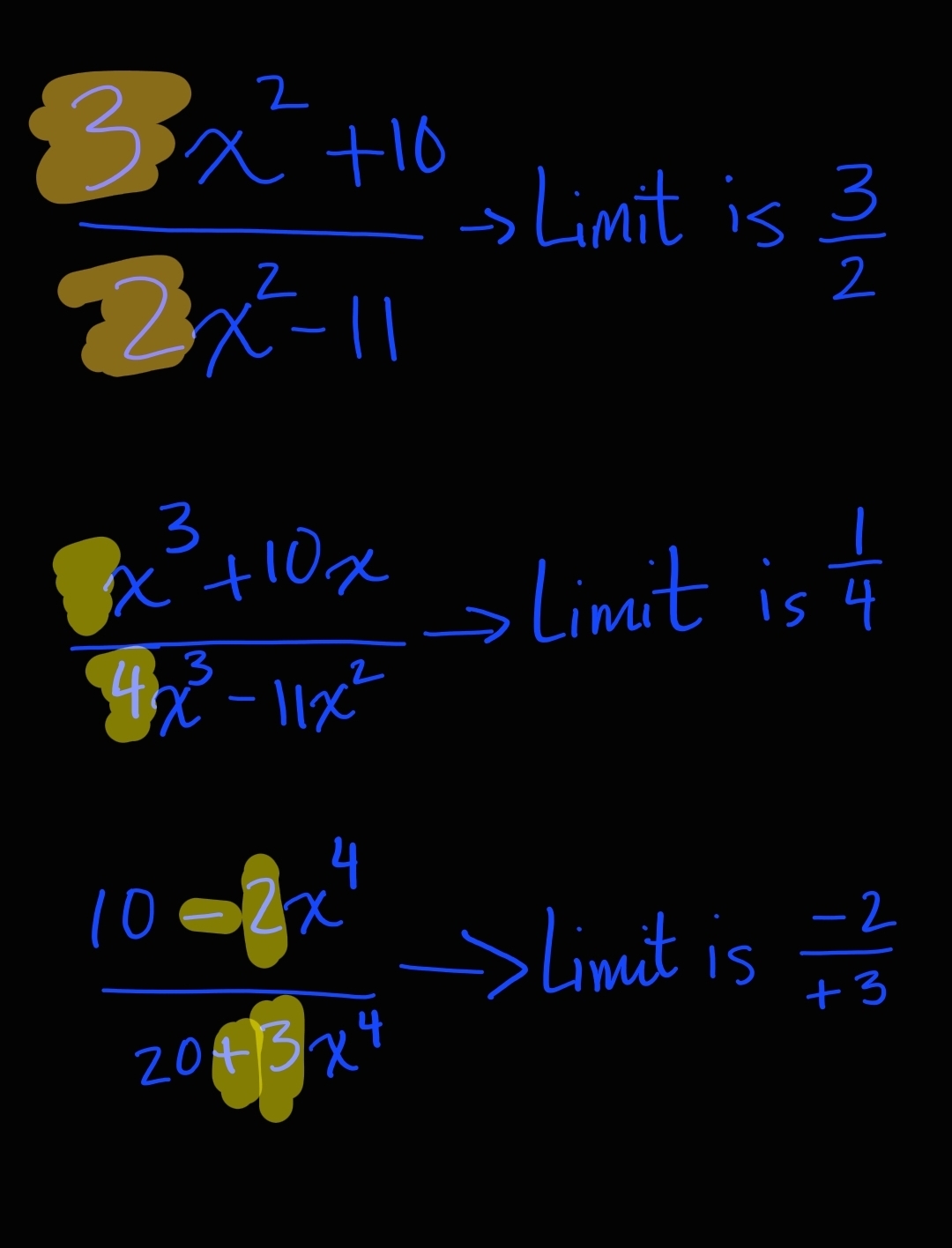
Note: Even if the limit is $\lim_{x \to -\infty }f(x)$, this would be true.

$x$ going to negative infinity
It can be a little confusing in comparison to $x$ simply going to positive infinity, but it is easier if you agree with the below statements:
If $x$ is raised to an even power ($x^{2},\ x^{4},\ x^{6},\ x^{8},\ ...$), does it matter if $x$ is a positive or negative number? No. Why?
Let us suppose $x=3$. Then $x^{2}=3\cdot 3=9$.
What if $x=-3$? Then $x^{2}=-3\cdot -3=9$
As you see, the answer is the same because the power is even.If $x$ is raised to an odd power ($x,\ x^{3},\ x^{5},\ x^{7},\ x^{9},\ ...)$, does it matter if $x$ is a positive or negative number? Yes. Why?
Let us suppose $x=3$. Then $x^{3}=3\cdot 3\cdot 3=27$.
What if $x=-3$? Then $x^{3}=-3\cdot -3\cdot -3=-27$
So it matters because the power is odd.You need to relate the above 2 statements also to coefficients. Assume you have $-2x^{3}$ and $x=-3$. We know that $x^{3}=(-3)^{3}=-27$, but we then we have to multiply with $-2$, giving us $-2(-27)=+54$.
So in summary: The sign of $x$ matters only if the power of $x$ is odd. If the power is even, then the value of $x^{power}$ will always be positive (summary of the first 2 bulletpoints). Moreover, you must then multiply with the sign of the coefficient to find the sign of the final answer (summary of the last bulletpoint).
Now, you have to relate this back to the scenarios above, as the sign of your answer (whether the answer is $+\infty \ or\ -\infty )$ may need to be flipped. You must only consider the leading term. For rational functions, you must consider the leading terms for both the top and the bottom when you are deciding whether you have positive infinity or negative infinity as your answer.
I will show you 2 examples.
$\lim_{x \to -\infty }-2x^{3}+2x^{2}+1$
- We only care about the leading term, which in this case is $-2x^{3}$
- Since we are going to negative infinity, then $x^{3}$ is getting more and more negative.
- So we have $-2$ getting multiplied by $-\infty$
- A negative times a negative is a positive
- The answer is positive infinity.
$\lim_{x \to -\infty }\frac{x^{4}+3x^{3}+4}{x^{3}+10}$
- Again, we only care about leading terms. f(x) is top heaving in this case, so we know our answer will either be $-\infty \ or\ +\infty$
- Looking at the top, our leading term is$\ x^{4}$. The power is even (it's 4), so we know that the top will be positive.
- Looking at the bottom, the leading term is $x^{3}$. The power is odd (it's 3), so $x^{3}$ will be negative. Hence, the bottom is negative.
- So we have $\frac{\text{positive}}{\text{negative}}=\text{negative}$. So the answer is $-\infty$ or negative infinity