Implicit Differentiation
If I asked you to find $\frac{dy}{dx}$ for this $y=x^2+3x$ (remember, $\frac{dy}{dx}$ is just another way of saying: the derivative of this line $y=x^2+3x$), you can hopefully figure out the derivative using the tricks and rules I gave you. This is because the $x$ and $y$ are completely separated from each other, and the equation is given to you in the form $y=$ something with only $x$ as the variable.
What if I told you to differentiate $x^2+y^2=1$ without making it into the form $y= ...$. Can you do it using the differentiation rules I gave you? Well… kinda.
Here are the rules for implicit differentiation. ▼
- You will differentiate both sides of the equation (the right and left hand side)
- If you are differentiating a term that has $y$ in it, first treat $y$ as if it's a regular function that you are used to differentiating (apply the rules you learned normally) and then multiply that derivative by $\frac{dy}{dx}$ (so coming back to the $y^2$ example, after applying the power rule, you get $2y$. After getting that, multiply it with $\frac{dy}{dx}$. So your final answer for the derivative of $y^2$ is $2y \cdot \frac{dy}{dx}$)
- If you are dealing with constants or $x$ variables, just do your work normally as you previously learned.
- After you are done with all your differentiation, you must express your equation in the form $\frac{dy}{dx}=...$. In other words, factor that $\frac{dy}{dx}$ and make it the subject of your equation.
It is very important you go step-by-step to avoid some silly mistakes.
Let's work on some examples.
- $x^2+y^2=1$
- I will first differentiate everything like we were previously taught using the differentiation rules.
- Let's work on the left hand side.
Let's look at $x^2$. From the power rule, it will be $\frac{d}{dx}(x^2)=(2 \cdot 1)x^{2-1}=2x$
Ok, now the next term: $y^2$. As we said in the rules, I will treat it as if it's a normal function, so I will apply the power rule on it to get $2y$. But since I differentiated something with $y$, I must multiply that derivative by $\frac{dy}{dx}$. So in the end, we get $\frac{d}{dx}(y^2)=2y\frac{dy}{dx}$
So my left hand side becomes: $2x+2y\frac{dy}{dx}$ - The right hand side is just a constant, and as we previously said, constants simply become $0$.
- So our equation now looks like this: $2x+2y\frac{dy}{dx}=0$
- Separate $\frac{dy}{dx}$ and make it the subject.
$2x+2y\frac{dy}{dx}=0$
$2y\frac{dy}{dx}=-2x$
$\frac{dy}{dx}=\frac{-2x}{2y}=-\frac{x}{y}$ (I cancelled the $2$ from the fraction) - After you find that $\frac{dy}{dx}$ is now the subject of the equation, you have officially done it!
- $19x+\frac{2}{3}y^3 \cdot \sin x-4^x=\ln(x^2+4)$
- A terrible expression, indeed. I recommend looking at it and guessing the rules you have to use. Follow along and see if you guessed correctly.
- We will start from the left hand side. We will go term by term.
The first term is $19x$. Since $x$ has a power of $1$, we can just remove it, giving us $\frac{d}{dx}(19x)=19$ - The second term is $\frac{2}{3}y^3 \cdot \sin x$. This is 2 big functions getting multiplied together. We must use the product rule. Just so you don't get confused, I will call my first function $u$ and the second one $v$. I'm doing this to avoid some bad notation. My first function is $u=\frac{2}{3}y^3$ and the second one is $v=\sin x$.
I need to find the derivative of each. Let's start with $u'=\frac{d}{dx}(\frac{2}{3}y^3)$.
Again, I'm differentiating $y$, so I will treat it as if it's something normal, and then multiply by $\frac{dy}{dx}$.
$\frac{d}{dx}(\frac{2}{3}y^3)=(\frac{2}{3} \cdot 3)y^{3-1} \cdot \frac{dy}{dx}=2y^2\frac{dy}{dx}$
Now $v'=\frac{d}{dx}(\sin x)$. This is just testing your memory. It is $v'=\cos x$.
We can finally use the product rule now ($\frac{d}{dx}(uv)=uv'+u'v$)
$\frac{d}{dx}(\frac{2}{3}y^3 \sin x)=(\frac{2}{3}y^3)(\cos x)+(2y^2\frac{dy}{dx})(\sin x)$ - We move on to the third term. This is again just testing your memory. Recall this.
$\frac{d}{dx}(4^x)=4^x \cdot \ln 4$ - We have finally finished differentiating the left hand side. It is $19+\frac{2}{3}y^3\cos x+2y^2\sin x\frac{dy}{dx}-4^x \cdot \ln 4$
- Looking at the right side, it is both testing your memory and the chain rule, because you have a function inside a function. Look at the image below:
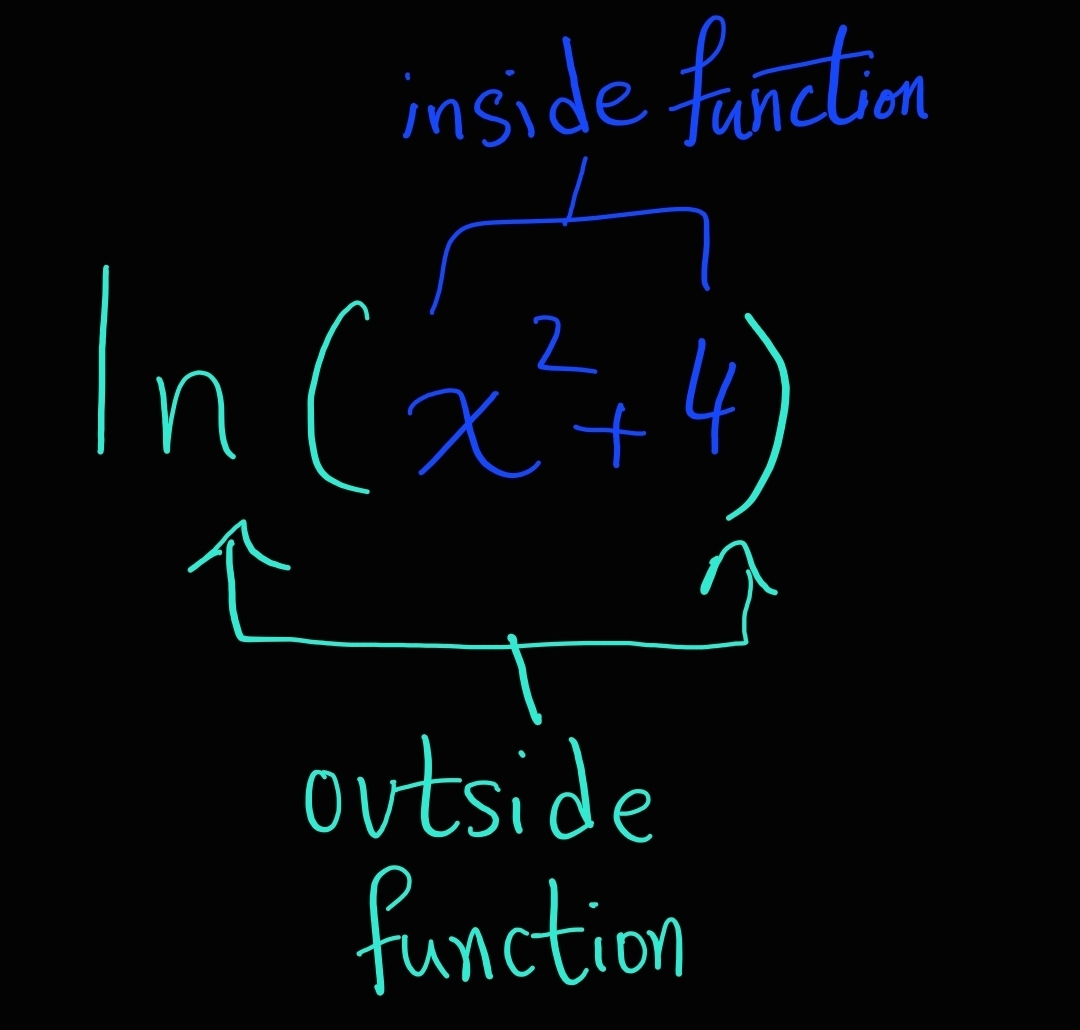
- We will differentiate the outside function, keeping the inside the same, and then multiply everything by the derivative of the inside.
Using your memory: the derivative of $\ln x$ is $\frac{1}{x}$ (so, wherever we see an $x$, we will replace it with $x^2+4$ to get the derivative of the outside function)
So, $\frac{d}{dx}[\ln(x^2+4)]=\frac{1}{x^2+4} \cdot \frac{d}{dx}(x^2+4)=\frac{1}{x^2+4} \cdot (2x)=\frac{2x}{x^2+4}$ - We are finally done differentiating everything. Our equation is $19+\frac{2}{3}y^3\cos x+2y^2\sin x\frac{dy}{dx}-4^x \cdot \ln 4=\frac{2x}{x^2+4}$
Our last step is to separate $\frac{dy}{dx}$. - $19+\frac{2}{3}y^3\cos x+2y^2\sin x\frac{dy}{dx}-4^x \cdot \ln 4=\frac{2x}{x^2+4}$
- $2y^2\sin x\frac{dy}{dx}=\frac{2x}{x^2+4}-19-\frac{2}{3}y^3\cos x+4^x \cdot \ln 4$
(in this step I moved everything that doesn't have $\frac{dy}{dx}$ to the other side, making sure to flip the sign) - $\frac{dy}{dx}=\frac{\frac{2x}{x^2+4}-19-\frac{2}{3}y^3\cos x+4^x \cdot \ln 4}{2y^2\sin x}$
(in this step I divided by $2y^2\sin x$ to completely separate $\frac{dy}{dx}$)
- $19+\frac{2}{3}y^3\cos x+2y^2\sin x\frac{dy}{dx}-4^x \cdot \ln 4=\frac{2x}{x^2+4}$
- $\frac{dy}{dx}$ is on its own, so we did it!

I understand that in these examples, you could probably separate $y$ to be on its own before differentiating. I have no problem with that and sometimes that's the best way to do it. But with some equations, it's either impossible or not a smart thing to do because the resulting function will be a nightmare to differentiate.
I hope this was good practice with derivatives. We will now move on to our last topic.