Quotient Rule
This is the last major rule in differentiation. You use it when you have 2 functions dividing with one another. The top function will always be $f(x)$ and the bottom function will always be $g(x)$.
Here is the formula:
$$\frac{d}{dx}\left(\frac{f(x)}{g(x)}\right)=\frac{f'(x)\cdot g(x)-f(x) \cdot g'(x)}{[g(x)]^2}$$
Here's a bigger picture of the formula because the equation is hard to see.

This rule should be the first thing that comes to mind (if you can't simplify) when you are asked to differentiate a fraction of 2 functions. I will do 1 example to help you see how to use it.
- $\frac{x^3+3x^2+5x+7}{\sqrt[4]{x}+\frac{3}{x^2}}$
- See a fraction that we want to differentiate? Think of the quotient rule.
The top of the fraction will always be your $f(x)$, the bottom will always be your $g(x)$. You need to find the derivatives of each to plug into your formula. - Our $f(x)=x^3+3x^2+5x+7$. To find $f'(x)=\frac{d}{dx}(x^3+3x^2+5x+7)$, we will use the power rule and separate the terms.
$\frac{d}{dx}(x^3+3x^2+5x+7)=\frac{d}{dx}(x^3)+\frac{d}{dx}(3x^2)+\frac{d}{dx}(5x)+\frac{d}{dx}(7)$
$=(3 \cdot 1)x^{3-1}+(3 \cdot 2)x^{2-1}+5+0=3x^2+6x+5$ - Our $g(x)=\sqrt[4]{x}+\frac{3}{x^2}$. Remember from here that to use the power rule, we need to express our terms in the form of $ax^n$.
Let's start with $\sqrt[4]{x}$. This is $x$ being raised to the 4th root. We can rewrite it as $x^{\frac{1}{4}}$.
Next, $\frac{3}{x^2}$. To remind you, if your $x$ is down and you want to raise it up, simply do so but turn its power negative. So, we can rewrite this as $3x^{-2}$.
So $g(x)=x^{\frac{1}{4}}+3x^{-2}$. We can now use the power rule.
$g'(x)=\frac{d}{dx}(x^{\frac{1}{4}})+\frac{d}{dx}(3x^{-2})=(1 \cdot \frac{1}{4})x^{\frac{1}{4}-1}+(3 \cdot -2)x^{-2-1}$
$=\frac{1}{4}x^{-\frac{3}{4}}-6x^{-3}$.
I will simplify:
$=\frac{1}{4\sqrt[4]{x^3}}-\frac{6}{x^3}$ - We finally have everything we need to plug into the formula
$\frac{d}{dx}\left(\frac{f(x)}{g(x)}\right)=\frac{f'(x)\cdot g(x)-f(x) \cdot g'(x)}{[g(x)]^2}$
Here is a picture of the answer with everything plugged in.
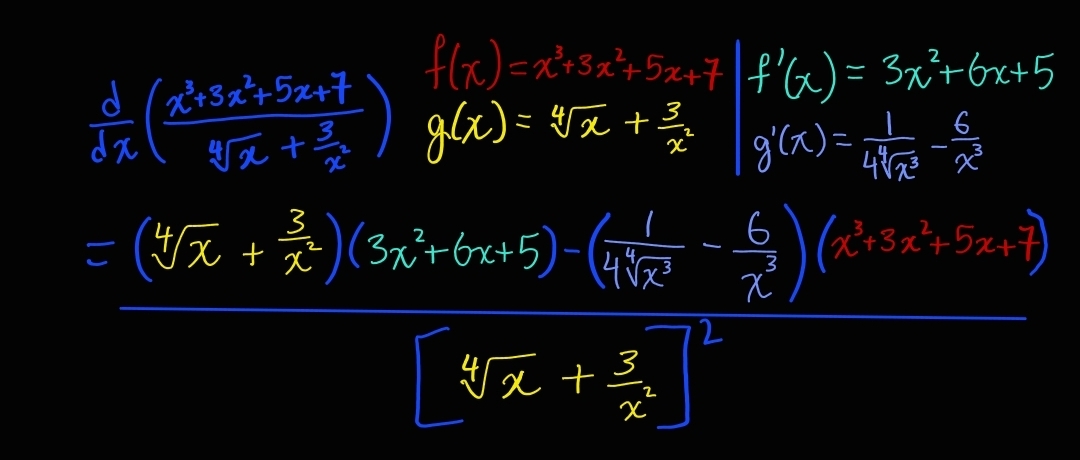
I don't recommend trying to simplify such expressions.
- See a fraction that we want to differentiate? Think of the quotient rule.
