Product Rule
You use this when you have two functions multiplying with each other. The formula to differentiate is:
$$\frac{d}{dx}[f(x) \cdot g(x)]=f'(x) \cdot g(x)+f(x) \cdot g'(x)$$
Examples: (second example has pictures)
- $(x^3-2x)(4x^2+3)$
- First, identify your 2 functions. As a good rule of thumb, look for 2 or more big things multiplying with each other. You can hopefully see that $(x^3-2x)$ is one big thing and $(4x^2+3)$ is another big thing.
- I will make $f(x)=(x^3-2x)$ and $g(x)=(4x^2+3)$
Note: It doesn't matter in the product rule if you flip them, making $f(x)=(4x^2+3)$ and $g(x)=(x^3-2x)$. - Now, find the derivative of $f(x)$ and $g(x)$ separately.
- To find $f'(x)=\frac{d}{dx}(4x^2+3)$ we will use the power rule and separate the terms from each other.
$\frac{d}{dx}(4x^2+3)=\frac{d}{dx}(4x^2)+\frac{d}{dx}(3)=(4 \cdot 2)x^{2-1}+0=8x$ - To find $g'(x)=\frac{d}{dx}(x^3-2x)$, we will do the same as step 4
$\frac{d}{dx} (x^3-2x)=\frac{d}{dx}(x^3)-\frac{d}{dx}(2x)=(1 \cdot 3)x^{3-1}-2=3x^2-2$ - We will now input the values in our formula
$\frac{d}{dx}[f(x) \cdot g(x)]=f'(x) \cdot g(x)+f(x) \cdot g'(x)$
$\frac{d}{dx}[(x^3-2x)(4x^2+3)]=(8x)(x^3-2x)+(4x^2+3)(3x^2-2)$
You can simplify if you wish.
- $(17x^9-22x^3)^5(x^2+3x+1)^4$
- Note: this one will require you to use all rules we went over so far.
- Our 2 big functions that are multiplying with each other are $f(x)=(17x^9-22x^3)^5$ and $g(x)=(x^2+3x+1)^4$.
- Let's find $f'(x)=\frac{d}{dx}(17x^9-22x^3)^5$. We need to use the chain rule. I will highlight the big outside function in $f(x)$ and also the inside function.
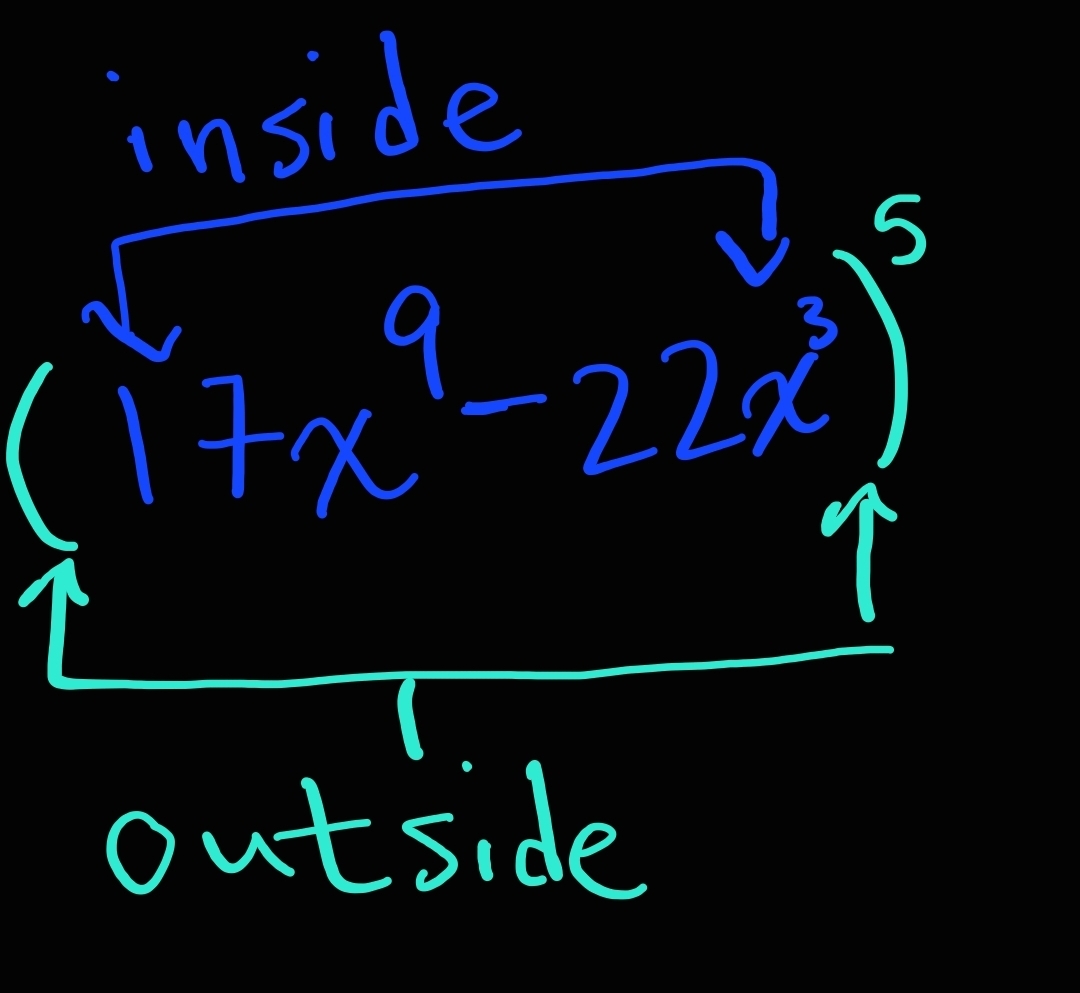
Remember, differentiate the outside while keeping the inside the same, and then multiply by the derivative of the inside.
$\frac{d}{dx}(17x^9-22x^3)^5=5(17x^9-22x^3)^4 \cdot (153x^8-66x^2)$
Steps to do this were done here. - Now, we need to find $g'(x)=\frac{d}{dx}(x^2+3x+1)^4$
We will once again use the chain rule. I will highlight the outside and inside functions.
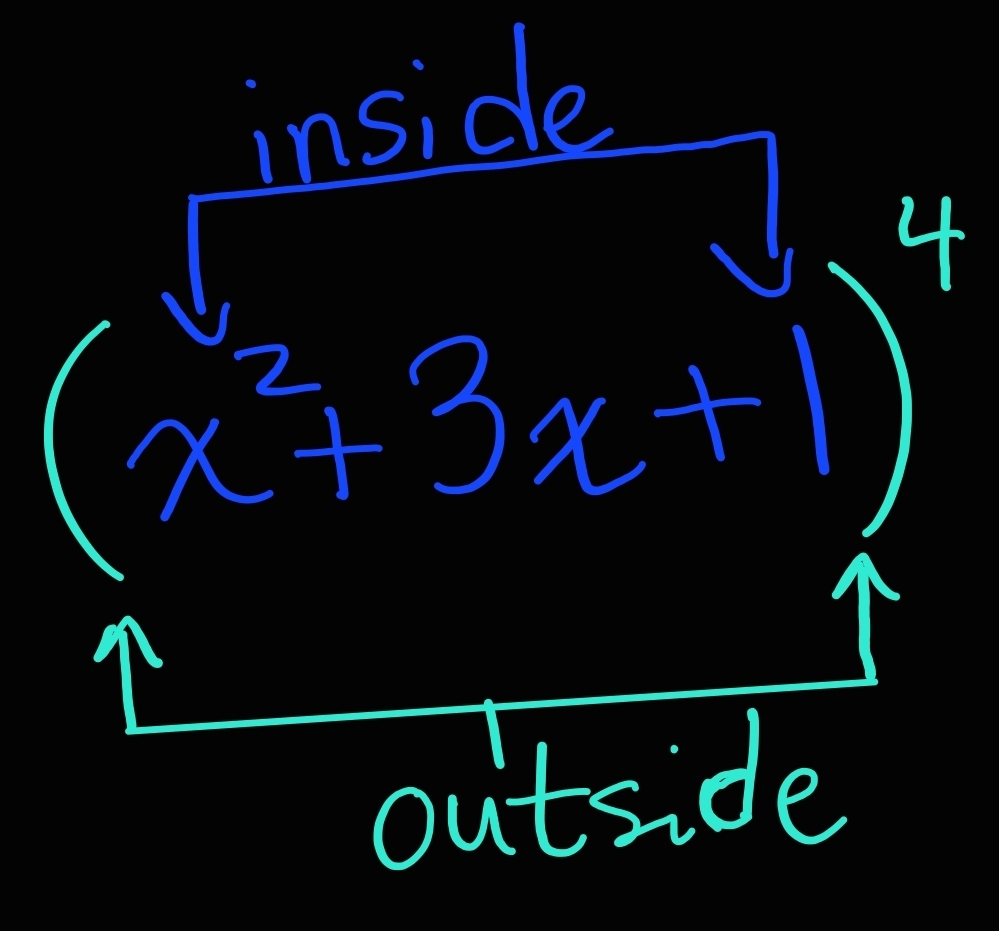
Now, take the derivative of the outside function while keeping the inside the same, and then multiply everything by the derivative of the inside.
$\frac{d}{dx}(x^2+3x+1)^4=4(x^2+3x+1)^3 \cdot (2x+3)$
If you want more detailed steps, go here. - We now have everything we need to plug into the formula of the product rule $\frac{d}{dx}[f(x) \cdot g(x)]=f'(x) \cdot g(x)+f(x) \cdot g'(x)$
- $\frac{d}{dx}[(17x^9-22x^3)^5(x^2+3x+1)^4]=$
$5(17x^9-22x^3)^4(153x^8-66x^2)(x^2+3x+1)^4+(17x^9-22x^3)^5 \cdot 4(x^2+3x+1)^3(2x+3)$
You can simplify if you wish, but I don't think it's worth it.
- $x(4x^2+1)$
- You can distribute the $x$ and just use the power rule if you wish.
I'm doing this example just to show you that the product rule doesn't necessarily require huge functions to be used on. In this case, our first big function is $f(x)=x$ and the second big function is $g(x)=4x^2+1$ - We need to find $f'(x)=\frac{d}{dx}(x)$. Remember from this section that it will just be the constant next to the $x$, which in this case is just an invisible $1$. So $f'(x)=1$
- To find $g'(x)=\frac{d}{dx}(4x^2+1)$ we will use the power rule and separate the terms.
- $\frac{d}{dx}(4x^2+1)=\frac{d}{dx}(4x^2)+\frac{d}{dx}(1)=(4 \cdot 2)x^{2-1}+0=8x$
The one disappeared because it's a constant, and the derivative of a constant is $0$. - We can now use the product rule.
$\frac{d}{dx}[x(4x^2+1)]=1(4x^2+1)+x(8x)=4x^2+1+8x^2=12x^2+1$
If you decide to distribute the $x$ and just use the power rule, you will get the same answer.
Typically, since distributing is relatively easier here, I would distribute and just use the power rule.
- You can distribute the $x$ and just use the power rule if you wish.

