Introduction to Integration and the Reverse Power Rule
Integration is the reverse of derivatives. Imagine I was teaching you how to build a house using some bricks. Now, I'm teaching you to break down that house and give me my bricks back. A good rule of thumb is to remember your derivatives and think backwards.
Possible uses of integration. ▼
- To find the area under a curve. Here are some examples to help you imagine it.
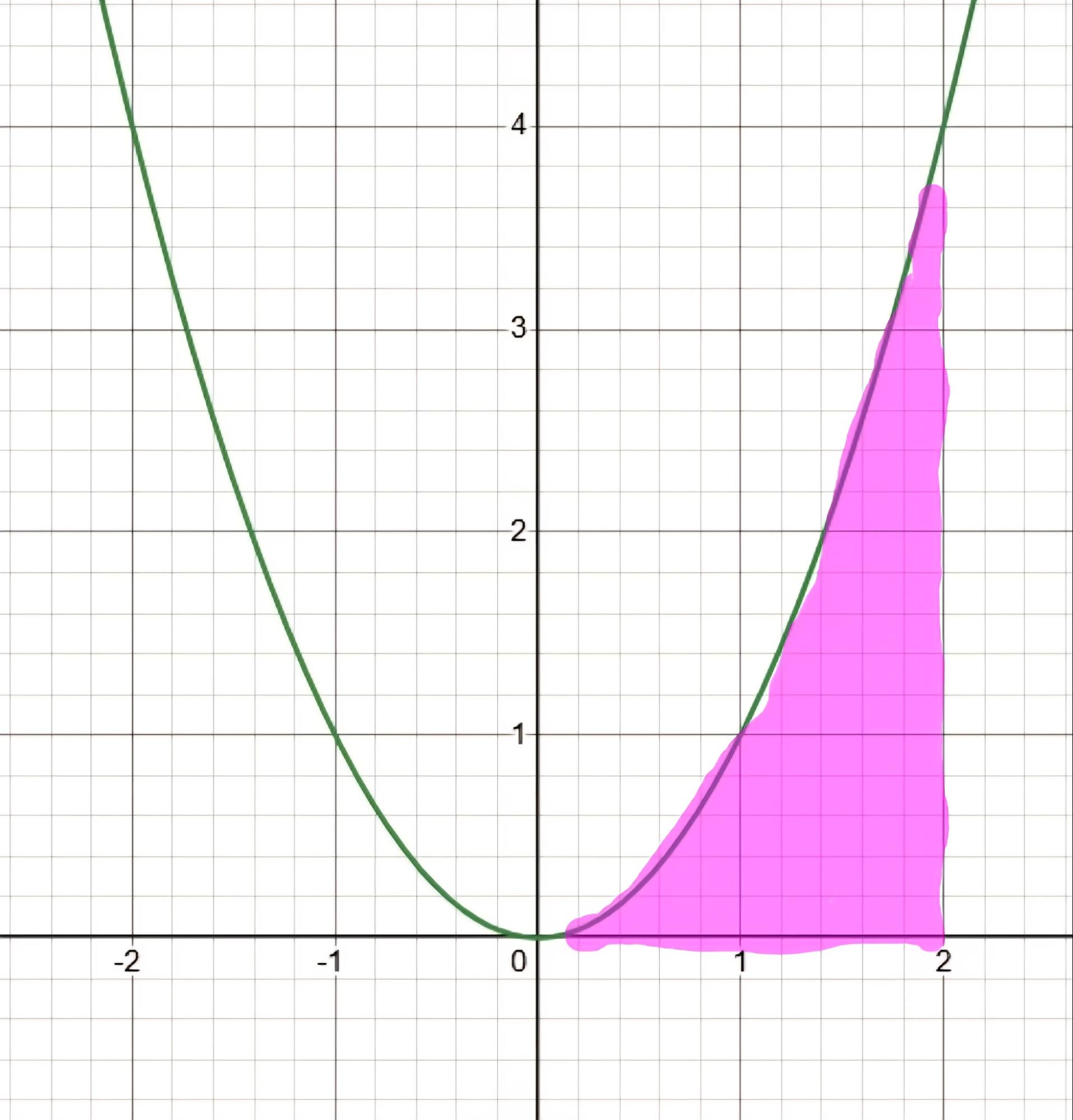
- Below is the graph of $y=x^2$. The pink highlighted area is the area under the curve from $x=0$ to $2$
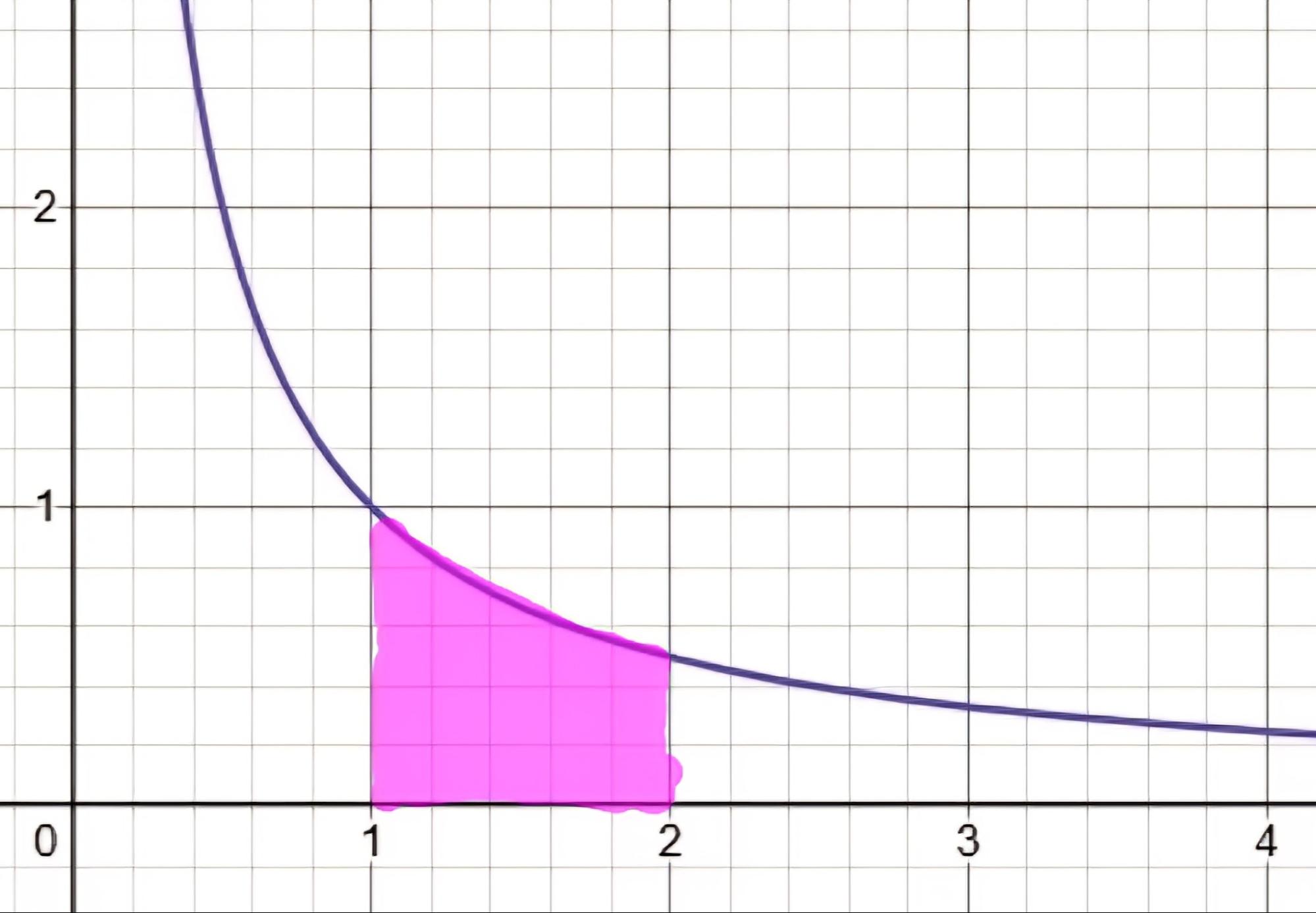
- Below is the positive portion of the graph $y=\frac{1}{x}$. The pink highlighted area is the area under the curve from $x=1$ to $2$.
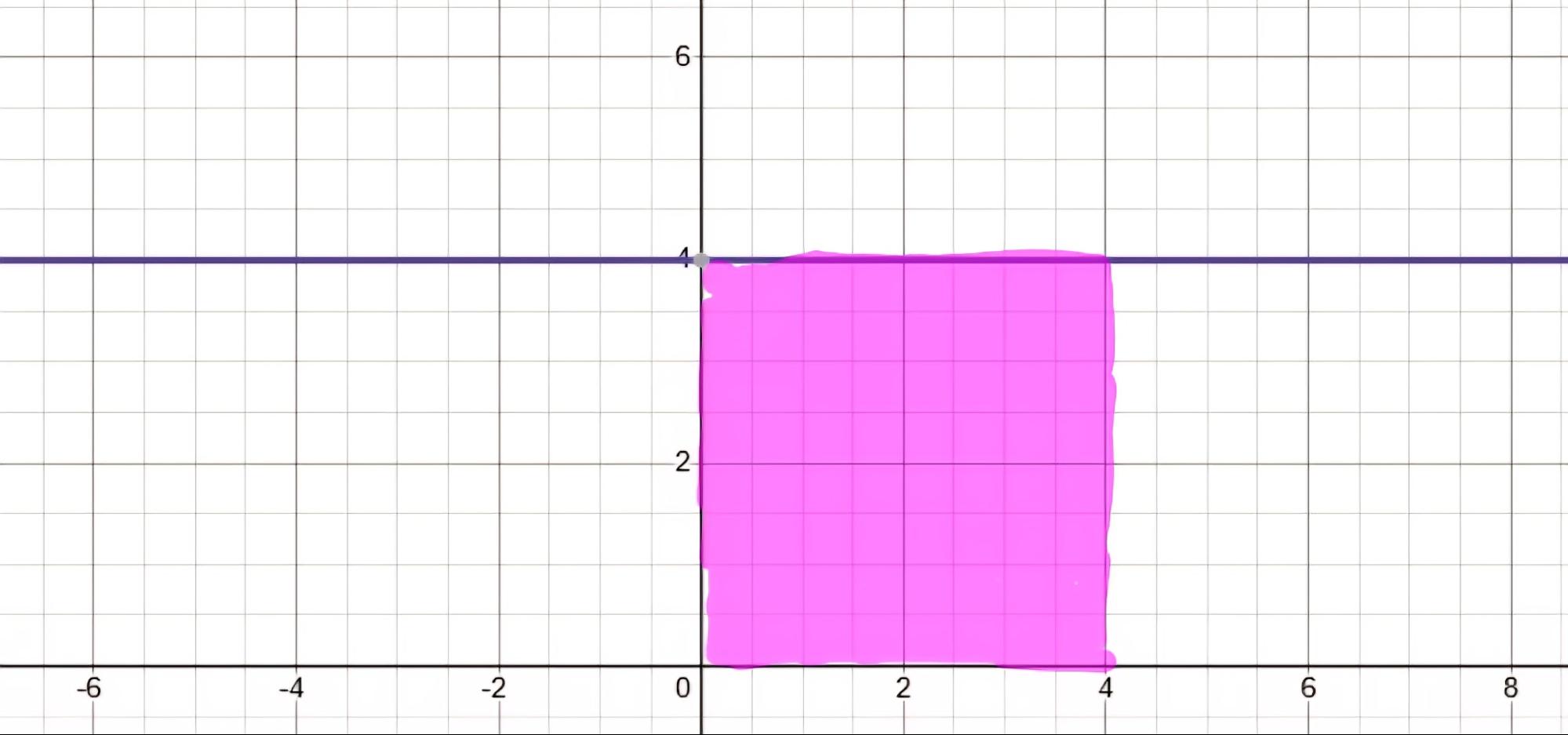
- Below is the graph for $y=4$. The highlighted area is the area under the curve from $x=0$ to $4$
- Below is the graph of $y=x^2$. The pink highlighted area is the area under the curve from $x=0$ to $2$
- Trace back the acceleration of an object based on its position graph and other known variables.


Symbol for integration:
$$\int f(x) \, dx$$ This is known as an indefinite integral. That swiggly line has nothing on it.
$$\int_a^b f(x) \, dx$$ This is known as a definite integral. The $a$ is usually the lower $x$ value and the $b$ is usually the bigger $x$ value. You will see this form when you are trying to find the area under the curve $f(x)$ from a specific interval. For example, in the first example in the "area under the curve" explanation, we were finding the area from the interval $0$ to $2$ (in this case $a=0$ and $b=2$), and our $f(x)=x^2$. Hence that highlighted area is equal to $\int_0^2 x^2 \, dx$.
Last thing to mention about symbols, the google doc symbol for the definite integral is a bit weird (the letters aren't supposed to be directly above and below the swiggly line). I drew a maybe-better visual for you to see

Before I give you the first rule, let's try to work off what we already know about integration: it is the reverse of differentiation.
Consider this $f'(x)=2x$. We differentiated a function $f(x)$ and we got the derivative to be $2x$. What could $f(x)$ possibly be?
- Think of the power rule but in reverse. To remind you here is the power rule $\frac{d}{dx}(ax^n)=(a \cdot n)x^{n-1}$
- Let's start by looking at the power of $x$ in $f'(x)=2x$. We see that $x$ has a power of $1$ (which is invisible). The power rule decreases the power of $x$ by $1$, so to reverse the power rule: We must increase the power of $x$ by $1$. So the original power of $x$ was $2$.
- Good. Now in the power rule, we used to multiply the term by the original power. So to reverse the power rule, we must divide the term by the original power. Our original power was $2$ and we currently have $2x^2$, so after dividing we get $\frac{2x^2}{2}=x^2$.
- We have now completely reversed the power rule!
So, is our original $f(x)=x^2$? The answer is maybe.
Go back to the shortcuts I gave you in differentiation and recall this shortcut:
- If you have a constant all by itself like $10$, $3$, $1$, $\frac{3}{2}$, $40839$, ... The derivative of that will always be 0.
When I gave you $f'(x)=2x$, you have no way of telling whether I differentiated a constant or not. Hence, in order to overcome this mystery, you have to tell me "Your original $f(x)$ was $x^2$ + some constant." And yes, that constant could be $0$.
So, the official answer is $f(x)=x^2+C$ where $C$ is any real constant.
Don't believe me? Try to differentiate $f(x)=x^2+C$ and treat $C$ as any random number that comes to mind. You will return to $f'(x)=2x$, which I previously gave you.
Now, regarding the rules.
5.1 Rule #1 - Reverse of the basic rules
$$\int ax^n \, dx = \frac{ax^{n+1}}{n+1}+C$$


Again, there's a special case if you have $\int e^x \, dx = e^x+C$.
(Yellow arrow is the direction of the integration. I wanted to use the same picture to reinforce the idea of reversing differentiation)
For trigonometric functions, refer back to your differentiation rules and think backwards.
Examples:
- $\int 3x \, dx$
We will increase the power of $x$ by $1$ and divide by that new power.
$\int 3x \, dx=\frac{3x^{1+1}}{1+1}+C=\frac{3x^2}{2}+C$. Never forget your $+C$ in your indefinite integral. - $\int x^3 \, dx$
We will increase the power of $x$ by $1$ and divide by that new power.
$\int x^3 \, dx= \frac{x^{3+1}}{3+1}+C=\frac{x^4}{4}+C$. Never forget your $+C$ in your indefinite integrals. - $\int \cos x \, dx$
What is a function that when we differentiate we get $\cos x$? If you look back at your rules of differentiation, that function is $f(x)=\sin x$. So our final answer is $\int \cos x \, dx = \sin x + C$. - $\int \sin x \, dx$
What is a function that when we differentiate we get $\sin x$? Well, looking back at our rules of differentiation, we have $\frac{d}{dx}(\cos x)=-\sin x$. But we don't want that negative sign next to $\sin x$. Then we must multiply $\cos x$ by $-1$. Look: $\frac{d}{dx}(-1 \cdot \cos x)=-1(-\sin x)=\sin x$.
So our final answer is $\int \sin x \, dx=-\cos x+C$. - $\int \sec^2 x+\frac{3}{4x}-\frac{x^4}{2} \, dx$
Remember when I told you that you're allowed to separate the terms for differentiation? You can also do it for integration. So the above integral is equal to: $\int \sec^2 x \, dx +\int \frac{3}{4x} \, dx-\int \frac{x^4}{2} \, dx$
Let's go one by one.- $\int \sec^2 x \, dx$
This is testing your memory. What function do I differentiate to get $\sec^2 x$? That is $\frac{d}{dx}(\tan x)=\sec^2 x$.
So our final answer is $\int \sec^2 x \, dx=\tan x+C$. - $\int \frac{3}{4x} \, dx$
Well, hopefully you remember that $\frac{d}{dx}(\ln x)=\frac{1}{x}$. But what do we do with that $\frac{3}{4}$ on the top? Remember the property of differentiation where you can move constants outside? We can also apply it to integration.
So, $\int \frac{3}{4x} \, dx =\frac{3}{4} \cdot \int \frac{1}{x} \, dx=\frac{3}{4}\int \frac{1}{x} \, dx$
And we just said that we know that $\int \frac{1}{x} \, dx=\ln x$. So $\frac{3}{4}\int \frac{1}{x} \, dx=\frac{3}{4} \cdot (\ln x)+C=\frac{3}{4}\ln x +C$. - $\int \frac{x^4}{2} \, dx$
You can leave that $2$ in the bottom if you wish, but I will move it out to help you practice moving things.
$\int \frac{x^4}{2} \, dx=\frac{1}{2}\int x^4 \, dx$
Now we will use the reverse of the power rule.
$\frac{1}{2}\int x^4 \, dx=\frac{1}{2}\left(\frac{x^{4+1}}{4+1}\right)+C=\frac{1}{2}\left(\frac{x^5}{5}\right)+C=\frac{1 \cdot x^5}{2 \cdot 5}+C=\frac{x^5}{10}+C$.
- $\int \sec^2 x \, dx$